
MISSION
The NJABA Adult Services Workgroup is dedicated to promoting the professional practice of applied behavior analysis (ABA) in adult services and increasing both private and public capacity to provide high-quality, evidence-based behavior analytic services to all.
We provide support to current and prospective behavior analysts and strive to be a resource to third-party payers and government entities with the following:
- Division of Developmental Disabilities (DDD) – fee-for-service implementation and billing
- DDD Support Coordination Agencies and Coordinators – collaboration on Behavioral Support Services
- Required trainings
- State policies that facilitate and hinder service delivery
- Expanding opportunities and resources for adults in need of ABA services
2026 Meeting Schedule
Wednesday, April 15, 2026 10am-12pm via Zoom
Wednesday, June 17, 2026 10am – 12pm via Zoom
Wednesday, August 19, 2026 10am-12pm via Zoom
Workgroup meetings will be held via Zoom unless otherwise noted. The Zoom link is sent to workgroup members a few days prior to each meeting.
Please RSVP to the workgroup chair.
Interested, but unsure if you’d like to officially join? Come to a meeting to learn more and network with colleagues. All are welcome! For general inquiries, email info@njaba.org or 609-910-0394.
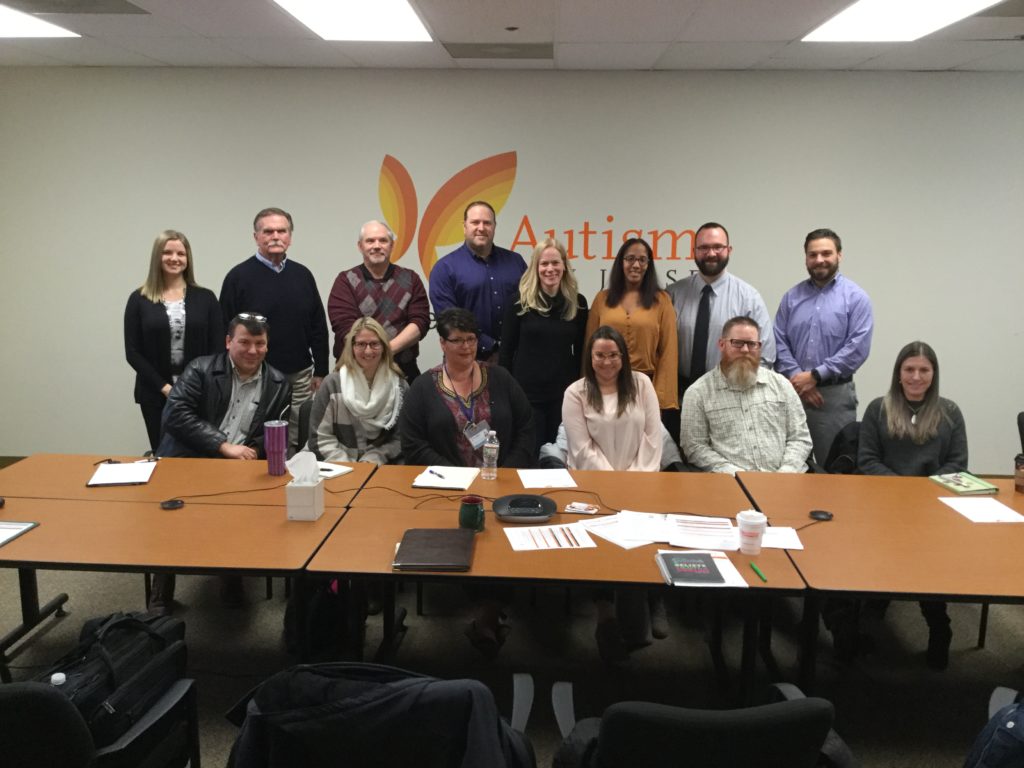
Great ASWG meeting on 1/16/19!
FAQ
Is there any state guidance on the provision of remote day services?
New Jersey Department of Human Services, Division of Developmental Disabilities – State Supplemental Payments for Day Providers FAQs
Where can I obtain information about publicly funded services for adults with developmental disabilities?
State-funded services for adults with developmental disabilities age 21 years and older are administered by the New Jersey Division of Developmental Disabilities.
I’m a behavior analyst, and I would like to become credentialed by DDD to work with adults. What steps do I need to take?
State-funded services for adults with developmental disabilities age 21 years and older are administered by the New Jersey Division of Developmental Disabilities.
What kind of assessments should I use to develop programming for adults with ASD?
As a general rule, parents and practitioners should use assessments to identify skills that are of practical relevance and promote independence. Some useful assessment tools include:
Autism Speaks Community-Based Skills Assessment
Where can I learn more about the history of adult services?
Gerhardt, P. F., & Lainer, I. (2011). Addressing the needs of adolescents and adults with autism: A crisis on the horizon. Journal of Contemporary Psychotherapy, 41(1), 37-45.
Henninger, N. A., & Taylor, J. L. (2013). Outcomes in adults with autism spectrum disorders: A historical perspective. Autism, 17(1), 103-116.
What is Support Coordination?
Support Coordination (SC) is a DDD-funded service that assists individuals in gaining access to needed program and State plan services, as well as needed medical, social, educational and other services. All individuals who are eligible for and wish to access DDD-funded services must either select or be assigned to a Support Coordination Agency (SCA).
The Support Coordination Agency assigns a Support Coordinator to work with the individual and his/her family to ensure completion of the Person-Centered Planning Tool (PCPT) and to develop the Individualized Service Plan (ISP). See Choosing a Support Coordination Agency for guidance on selecting a support coordinator.
How do I develop an Individualized Service Plan?
In collaboration with the Support Coordinator, the Individualized Service Plan is developed by the individual and an interdisciplinary team (IDT). The IDT consists of the individual, his or her parent(s) or guardian(s), and a team of professionals that may include a social worker, doctor/nurse, DSP, nutritionist, psychologist/psychiatrist, QIDP, OT/PT, teacher, residential representative, day program representative, vocational representative or job coach. The individual should be interviewed and evaluated on job experience, educational background, employment skills, potential, need for supportive services and interests should be evaluated. Activities, supports, and resources required to achieve the individual’s personal goals are detailed in the document. The ISP and contract should be reviewed by the individual and the representative at least every six months.
I have concerns about the practices of a behavior analyst. What can I do about it?
If you suspect abuse or neglect, review Unusual Incident Reporting forms and instructions
If you have concern with the professional practice of a New Jersey licensed behavior analyst, review Applied Behavior Analyst Examiners Regulations
If you have concern with the ethical practices of a board certified behavior analyst, review Ethics Code for Behavior Analysts
What are some resources for programming for adults with ASD?
Danya International, Inc., Organization for Autism Research & Southwest Autism Research & Resource Center. (2006). Life journey through autism: A guide for transition to adulthood. Arlington, VA: Organization for Autism Research, Inc.
Luiselli, J. K. (Ed.) (2011). Teaching and behavior support for children and adults with autism spectrum disorder: A practitioner’s guide. New York, NY: Oxford University Press.
Wehman, P. (2011). Essentials of transition planning. Baltimore, MD: Paul H. Brookes Publishing Co., Inc.
Wehman, P., Smith, M. D., & Schall, C. (2009). Autism and the transition to adulthood. Baltimore, MD: Paul H. Brookes Publishing Co., Inc.
I have a question about New Jersey licensure, where can I go to find the answer?
The most reliable source for licensure questions would be the Frequently Asked Questions tab
on the DCA State Board of Applied Behavior Analyst Examiners page.
It was also suggested that we add a submit your own question section to the ASWG site.